Real-Time Data Synchronization: Why It Matters for Your Business Operations

Quinn Johns • April 9, 2025

Outdated data isn't just inefficient; it's costly. That's why real-time data synchronization is a necessity.


The speed at which information moves through your company can make or break your marketplace advantage. Technology is advancing so quickly that real-time synchronization between business systems isn't just a technical luxury—it's becoming a fundamental necessity for companies that want to stay ahead.


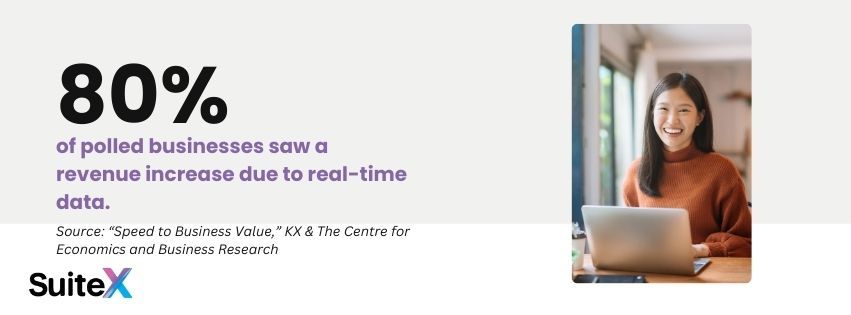
The Speed to Business Value” report from KX and the Centre for Economics and Business Research supports this idea. It says 80% of polled businesses in 2022 saw a revenue increase due to real-time data usage and an estimated $321 billion in savings from a reduction in non-people costs. Plus, real-time data systems contributed to more efficient process rollouts for 62% of surveyed companies. 


However, we know it’s challenging to implement the process and technology changes necessary to incorporate real-time data into your operations.


The SuiteX Integration Platform as a Service (iPaaS) bridges the gap between NetSuite’s enterprise-grade features and user-friendly interfaces, delivering all of the enterprise resource planning (ERP) system’s power without the complexity. It enables real-time data synchronization across business systems to eliminate information lags, reduce errors, and transform operations from reactive to proactive.


Read our guide below and learn why your company must have a steady stream of real-time data to compete and how the SuiteX iPaaS equips your team with the insight updates necessary to succeed. Then, schedule a free SuiteX demo with our experts to experience the software and discover how well your company can run.


Key Takeaways


  1. Bidirectional data flow creates a single source of truth. When systems communicate in real time, all departments work from the same information, eliminating contradictions and mistakes while enhancing collaboration and reducing manual entry.
  2. Data lag has significant financial consequences. According to Gartner, bad data costs organizations an average of $12.9 million yearly and impacts inventory management, manufacturing operations, and customer service. Software like the SuiteX iPaaS significantly reduces cost through real-time data flow while also expanding a NetSuite ERP’s capabilities.
  3. Manufacturing visibility challenges resemble "driving through fog." Manufacturers experience communication breakdowns, undetected bottlenecks, cascading quality issues, and resource allocation problems without real-time production insights.
  4. Real-time data synchronization helps satisfy customers. 98% of companies surveyed by KX reported increased positive customer sentiment when using real-time data synchronization, and 100% saw an improved ability to detect irregular activities.
  5. With real-time systems, quality control becomes preventive rather than reactive. SuiteX gives your quality control team digital tools that make inspections faster, more reliable, and fully traceable. Instead of slowing down production, quality control can help you move faster and deliver better products.


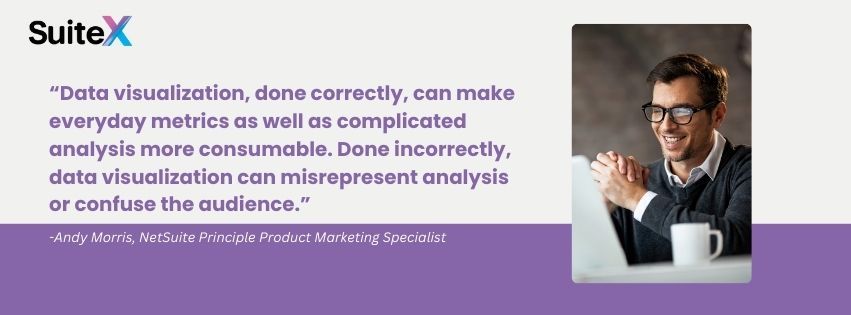
Quote from NetSuite's Andy Morris about data visualization.


The Power of Bidirectional Data Flow


Imagine your business systems as interconnected rivers. In this situation, data can flow freely between your ERP, CRM, inventory management, and e-commerce platforms in both directions, creating a robust ecosystem where information is always current, no matter where it's accessed.


This level of data sharing directly impacts the insights your company’s leadership can gain from its records—and consequently—affects the quality of decisions. 


“Data visualization, done correctly, can make everyday metrics as well as complicated analysis more consumable,” says NetSuite Principle Product Marketing Specialist Andy Morris. “Done incorrectly, data visualization can misrepresent analysis or confuse the audience.”


Bidirectional synchronization means that when data is updated in one system, those changes are immediately reflected in all connected systems. This two-way street creates several advantages:


  • Single Source of Truth: Employees across departments work from the same information, eliminating contradictory data that causes confusion and mistakes.
  • Operational Agility: When market conditions change, your organization can pivot based on real-time insights rather than yesterday's information.
  • Enhanced Collaboration: Teams can collaborate effectively when they all have access to the same customer information, inventory levels, and financial data.
  • Reduced Manual Entry: Information entered once updates everywhere, eliminating redundant data entry and the errors that inevitably come with it.


The Real Cost of Data Lag


When systems don't communicate in real time, the consequences can be far more serious than a simple inconvenience. The dissonance introduces inaccuracies, and according to Gartner, incorrect data costs companies an average of $12.9 million yearly. 


Here are concrete examples of how data lag impacts decision-making and operations:


Inventory Management Nightmares


Let’s say a retail business ran its e-commerce store and physical locations on separate systems that synchronized only once daily. During a flash sale, it continued selling a popular item online for hours after it had actually sold out in its warehouse because the inventory count wasn't updated in real time. As a result, customers were disappointed, shipments were expedited at a high cost to fulfill orders, and the brand’s reputation was damaged.


Real-time website updates would have shown accurate inventory levels, allowing the company to either stop selling the item or clearly mark it as back-ordered.


Graphic stating that 98% of surveyed companies experience increased positive customer sentiment when using real-time-data synchronization.


Manufacturing Visibility Challenges


There's a reason why supply chain visibility ranks among manufacturers' top priorities. When shop floor teams lack timely insights into production status, confusion and delays wreak havoc on daily operations.


Working without sufficient process insight is like driving through a dense fog without headlights. You're moving forward but unclear about what's ahead or around you. This manufacturing "fog" manifests in several ways:


  • Communication breakdowns between shifts and departments.
  • Production bottlenecks that go undetected until they cause significant delays.
  • Quality issues that cascade through the production line.
  • Resource allocation challenges when real-time data isn't available.


Modern integrated platform solutions address these challenges by providing real-time production tracking and status updates. These digital systems act like powerful spotlights, cutting through the fog and illuminating the entire production landscape. In fact, the KX “Speed to Business Value Report” says 100% of surveyed companies believed that real-time data access improved their ability to detect irregular activities.


This software usage results in smoother workflows, faster response times, and a more resilient manufacturing operation.


Customer Service Disconnects


Customer service representatives can’t resolve issues efficiently without access to up-to-date information. They also can’t provide accurate information about transactions or customer account changes if billing, shipping, and order management systems don't synchronize in real time.


These problems lead to longer resolution times, multiple calls for the same issue, and decreased customer satisfaction. Of course, on the other hand, adequate operational insight helps provide better, faster customer service. KX reports that 98% of surveyed companies experience increased positive customer sentiment when using real-time data synchronization.


Solving Synchronization Challenges


The technology behind real-time synchronization has evolved significantly, making powerful solutions more accessible than ever. Solutions like SuiteX's iPaaS platform bridge the gap between enterprise-grade features and user-friendly interfaces, allowing businesses to:


  • Create streamlined workflows with intuitive interfaces that simplify complex NetSuite processes.
  • Extend system access to production and quality teams without requiring full NetSuite licenses. (This feature can cut licensing costs by up to 50%.)
  • Implement real-time inventory control with automated material requirements planning.
  • Enable shop floor optimization through instant communication and resource tracking.


Graphic stating that 80% of polled businesses saw a revenue increase due to real-time data.


Quality Control Transformation


Quality management is one of the most impactful areas for real-time synchronization. Without immediate data flow, it becomes reactive rather than preventive. SuiteX addresses this by providing digital inspection checklists and comprehensive defect tracking that ensure consistent standards while maintaining complete audit trails.

This approach transforms quality control from a bottleneck into a competitive advantage, as issues are identified and resolved before they affect downstream operations or customer deliveries.


Implementing Real-Time Synchronization


As you evaluate your current systems and processes, ask these critical questions:


  • How long does it take for information to propagate across our business systems?
  • What decisions are being made with outdated information?
  • Where are we performing redundant data entry?
  • How would real-time visibility improve our customer experience and operational efficiency?


For manufacturing organizations specifically, consider how solutions like SuiteX can enhance your NetSuite implementation through:


  • Production control and efficiency improvements
  • Integrated quality control systems
  • Real-time shop floor communication
  • Complete inventory visibility
  • Performance metrics tracking


In an age where business moves at digital speed, the companies that can access, analyze, and act on information most quickly gain a substantial advantage. Real-time bidirectional data flow isn't just about technology—it's about creating an organization that can respond to challenges and opportunities when they arise. You’ll see how this works in real time during your free SuiteX demo. 


Get the Visibility You Need—Now! 


Business is becoming more competitive by the minute. Operations are speeding up, customer expectations are rising, and software is advancing rapidly. You don’t have time to wait on information lags. 


The SuiteX iPaaS offers real-time data synchronization that keeps your inventory in check, makes consumers happy, and cuts up to 50% of NetSuite licensing costs. Best of all, we can typically implement the software in less than a week. 


Schedule a free demo with our team today to learn more about the product and how it can make your company more efficient, productive, and successful.   


Headshot of Quinn Johns

Quinn Johns is the Technical Lead at SuiteX and has 18 years of experience as a full-stack developer. His expertise spans scalable database architecture, maintainable code development using established design patterns, and abstract problem-solving that transforms complex business challenges into elegant solutions. Quinn has demonstrated technical mastery across Laravel, PHP, JavaScript, and SQL while successfully building and leading diverse development teams on large-scale NetSuite-integrated projects. Currently, Quinn focuses on refining development processes, enhancing team efficiency, and creating meaningful career advancement opportunities for his colleagues. He lives in Montana with his wife and son.


Disclosure: This article was developed with the assistance of Claude, an AI created by Anthropic. Our editorial team used Claude as a collaborative writing tool, carefully reviewing, editing, and fact-checking all AI-generated content. The final text has been thoroughly vetted to ensure accuracy, clarity, and alignment with SuiteDynamics' editorial standards. We take full responsibility for the content presented in this article, maintaining our commitment to providing reliable and informative insights to our readers.


July 9, 2026
A Manufacturing Execution System is the software that sits between your ERP and your shop floor. While ERP manages the plan (what to build, when, and for whom) an MES manages the execution: dispatching work orders to operators, capturing labor and machine time, enforcing quality checks, tracking materials lot by lot, and recording exactly what was built and how. The international standard that defines MES functionality is ISA-95 (also known as the MESA model). It breaks manufacturing execution into several core domains: Production execution: Work order dispatch, electronic work instructions, operator clock-on/off Data collection: Real-time machine and operator data, barcode/RFID scan, manual entry Quality management: In-process inspections, non-conformance, CAPA tracking Traceability & genealogy: Lot/serial tracking, as-built records, recall readiness Performance analysis: OEE, downtime reasons, scrap rates, throughput Labor & resource management: Skills, certifications, labor capture against orders If you're managing any of these today, even informally, you're doing MES work. The question is whether your tools are keeping up with your operation. Isn't that what work orders in NetSuite are for? Sort of. NetSuite's native work order functionality is excellent for planning and financial purposes. It creates demand, allocates inventory, and closes out costs against the job. But it wasn't built for what happens between the moment a work order opens and the moment it closes. On the shop floor, a work order involves multiple operation steps, multiple operators across multiple shifts, real-time material issues, setup time, run time, scrap, rework, and quality holds. NetSuite records the result. An MES manages the process. NetSuite tells you a work order is done. SuiteX MES tells you how it got done… step by step, operator by operator, part by part. Key capabilities include: Work order creation, synced in real time Step-by-step operation dispatch, full routing with sequencing Operator-level labor capture with live start/stop at each step Built-in, step-level electronic work instructions Real-time completion tracking by operation and quanitity Automated OEE & downtime tracking with reason codes Lot/serial traceability  What does an MES actually look like in practice? In SuiteX MES, an operator on the floor starts their shift and opens a work order dashboard, configured to show exactly the jobs assigned to their workcenter, segmented by status and due today. They tap into a job and see their operation steps in sequence. Each MES card shows the routing step, the expected setup time and run time, and the work instructions for that operation, including drawings, SOPs, reference documents, all accessible without leaving the screen. The operator hits start, works the job, and hits complete. Time is captured automatically and posted against the work order in NetSuite without end-of-day catch-ups or manual re-entry. As they step through operations, the system sequences them to the next step automatically. If a step is partially complete, it flags it. When the final operation closes, a full summary displays the total units completed at each step, total run and setup time, and any issues logged. The work order is closed in NetSuite with a single tap. Signs your operation is ready for an MES You don't need to be running 24/7 continuous production to benefit from an MES. You need it when your current approach to managing the shop floor is creating friction, errors, or blind spots that cost you. Here are the most common signs: Paper travelers or whiteboards are your primary method of tracking work order status Labor time is entered after the shift, from memory, or not at all You find out about quality issues after parts have already moved downstream A customer asks for lot traceability on a shipped order and it takes hours to reconstruct You're estimating OEE or scrap rates rather than measuring them Operators ask supervisors which job to run next rather than seeing a live queue What about manufacturers who aren't quite there yet? MES doesn't require a mature operation. In fact, implementing MES often is how an operation matures. If you're currently on paper or spreadsheets, going directly to a native-ERP MES like SuiteX is often faster and cheaper than first building out manual processes and then replacing them later. The right question is whether the cost of your current approach, in labor re-entry, quality escapes, lack of visibility, and integration overhead, is higher than the cost of fixing it. For most discrete manufacturers on NetSuite, it is. An MES is the operating layer you are missing An MES connects your ERP plan to the reality of your shop floor. If you're running on NetSuite, SuiteX MES is the only solution that lives inside your existing system rather than alongside it. Schedule a demo to see SuiteX MES in action and speak with our team.

A man and a woman are sitting at a table looking at a laptop computer.
By Quinn Johns April 24, 2025
Discover how ERP interface complexity affects productivity and costs. Learn how SuiteX enhances NetSuite usability, driving financial results and ROI.

A man is sitting at a desk using a laptop computer.
By Quinn Johns April 10, 2025
Uncover the true price of manual data entry. Explore how inefficiencies drain resources and hinder growth, making a strong case for automation in your operations.

Man working on his computer in office
March 19, 2025
Specialized solutions are vital for any business in the software industry. Data siloes and inefficiencies, however, are not.

A man in a suit is using a tablet computer.
March 12, 2025
Discover how SuiteX simplifies change management in NetSuite, enabling rapid user adoption and effective communication to enhance workplace efficiency and satisfaction.

Workers on job site in yellow vests
March 11, 2025
The words "simple" and "manufacturing" almost never go together. Yet, SuiteX eases the complexity of NetSuite and daily operations so your team can work faster and better.

A group of people are sitting around a table having a meeting.
February 26, 2025
Discover the hidden costs of communication gaps in organizations. Learn how to enhance collaboration and reduce costly errors through effective communication tools.

A group of people are looking at a computer screen.
February 24, 2025
Explore the fundamentals of project hierarchies. Get best practices for task organization, managing dependencies in NetSuite, and maintaining project visibility.

Two women are sitting at a table looking at a tablet.
February 18, 2025
Build a strong foundation for team communication. Explore essential tips to promote psychological safety and ensure every voice is heard in your organization.

Two coworkers collaborate in front of a laptop.
January 24, 2025
SuiteX launches a cutting-edge NetSuite extension platform that revolutionizes enterprise software interaction, boosting productivity and reducing costs for organizations.
Show More